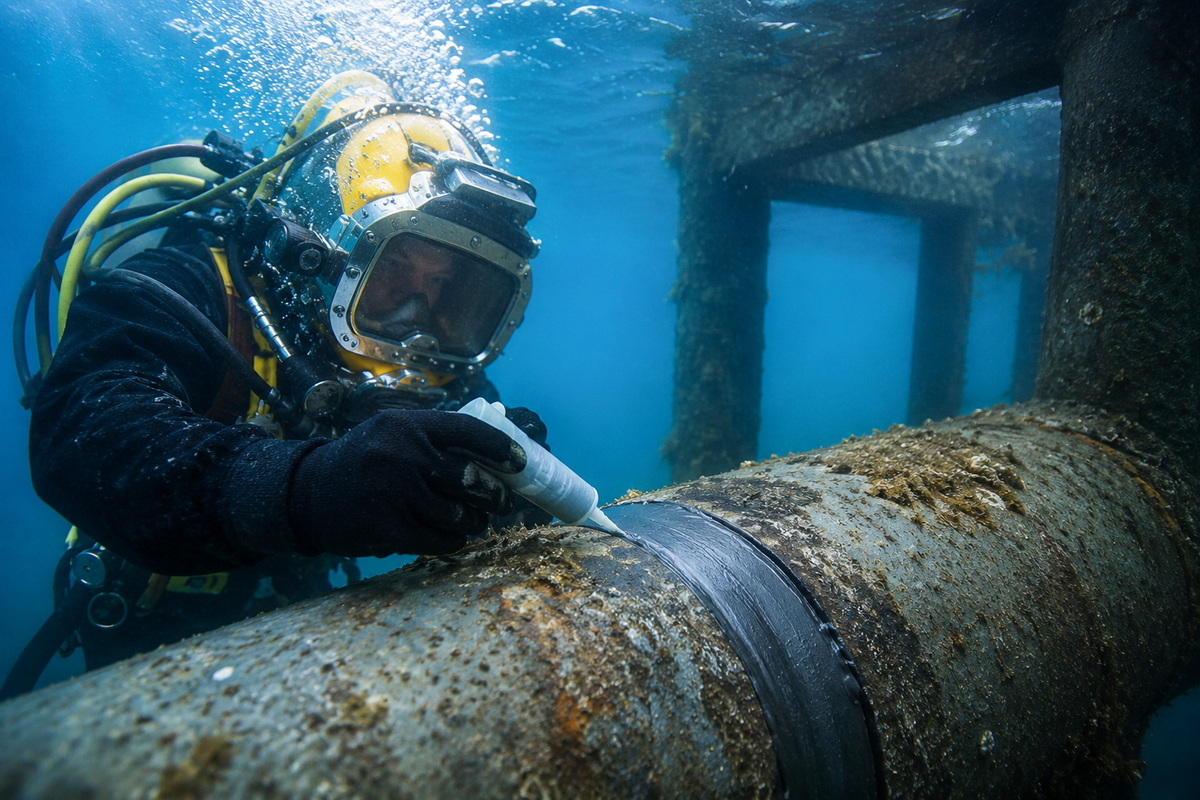
Adhesives are widely used in manufacturing and construction, but bonding surfaces underwater remains particularly difficult. Water forms a hydration layer on submerged materials that can prevent adhesives from making close contact with a surface and can weaken bonds over time.
Researchers have now developed a supramolecular underwater adhesive designed to overcome this problem. The material, described in a study published in Nature Communications, relies on a process known as solvent-exchange-mediated self-assembly.
The researchers created a supramolecular ionic liquid known as BP16TPB and dissolved it in dimethyl sulfoxide, or DMSO. When the mixture comes into contact with water, solvent exchange triggers a rapid rearrangement of its molecular components.
This causes the initially flowable material to assemble into a dense, water-resistant network capable of adhering to submerged surfaces.
According to the researchers, the process involves several molecular interactions, including hydrogen bonding, π–π stacking and electrostatic interactions. It is also assisted by the Marangoni effect, in which differences in surface tension drive fluid movement.
Together with the hydrophobic nature of the adhesive, this flow helps overcome the thin layer of water that normally prevents close contact between an adhesive and a submerged surface.
In laboratory experiments, the material bonded to surfaces including ceramic, epoxy and plastic. It reached an underwater adhesive strength of approximately 1.1 MPa after only 10 seconds of curing.
The researchers also tested the long-term durability of the bond. In one experiment, a bonded sample supported a 2 kg load during more than three years of continuous underwater immersion, indicating strong resistance to long-term degradation and deformation under a constant load.
The adhesive also showed some ability to be reused. During laboratory cycling tests, it could be detached and reattached underwater while retaining adhesive performance over eight cycles.
The researchers report that the material also remained functional in acidic, alkaline and saline solutions. However, its performance declined at temperatures above approximately 70°C (158°F) .
The findings could contribute to the development of new adhesives for underwater maintenance and other applications where conventional glues perform poorly. Potential uses could include marine infrastructure and other systems that require durable bonding in wet environments.
The researchers also suggest that the underlying self-assembly strategy could help guide the development of other environmentally responsive materials whose properties change when exposed to different surroundings.
Source: sciencealert.com